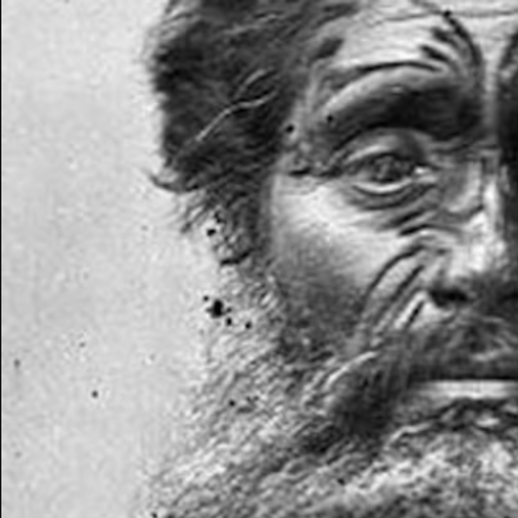
Kereopa Te Rau just days before he was executed for the murder of Carl Volkner. Photo/Alexander Turnbull
The Full Story - Symbol By Symbol
Tangohia te taura i taku kakī, kia waiata ahau i taku waiata.
Remove the rope from my neck, and allow me to sing my song.
— Ngā kupu a Mokomoko i mua i tōna matenga / The words attributed to Mokomoko before his death
Ko tēnei whārangi he kōrero mō ngā tohu — ōna tikanga, ōna hītori, ōna aroha.
Ehara ēnei tohu i te whakapaipai noa. Ko ia tohu, ia tohu, he kaupeka o te aho hohou rongo — he tūāhu kia mōhiotia ai: i pēnei te ao, ā, nā ngā mahi aroha ka huri.
Ko Hiona St Stephen's tētahi o ngā whare karakia iti rawa atu i Aotearoa — engari ko āna kōrero, ko ōna tohu, he nui ake i ngā kupu e āhei ana tētahi whare ki te tū. I konei, ka tūtaki ngā iwi e rua — ko te Māori, ko te Pākehā — ki ō rāua mamae, ki ō rāua tūmanako, ki ō rāua ara hou.
"The long journey that you have endured to restore the character, mana and reputation of your tīpuna must be commended. Your perseverance has not only had an impact on your whānau and uri — it has touched us all."
— Dr Pita Sharples, Minister of Māori Affairs, on the passing of the Mokomoko Bill, December 2013
Hiona St Stephen's Anglican Church is a small building on a quiet street in Ōpōtiki. But the symbols it carries are among the most significant acts of public reconciliation in Aotearoa New Zealand.
They were not easily won. They took generations. They cost families decades of grief, advocacy, and patient courage. And they now stand — carved above the door you walked through, framed under glass in the porch, woven into the name of this church — as testament to what is possible when people choose truth over convenience, and love over pride.
This page tells the story of those symbols.
Please feel free to wander round our church experiencing the peace to be found here. A peace that has been gained by the people of Christ working together and proclaiming the love of God, worshiping as one family.
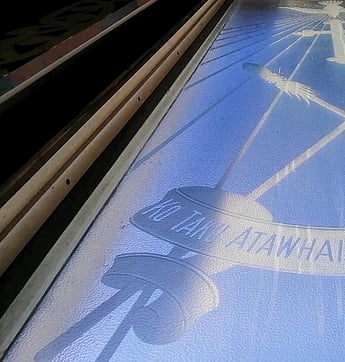
No reira waiho ko te aroha o Te Matua
Kaha Rawa hei korowai mōu
Let the love of Almighty God unfold you.
I. Two Men, One History — Völkner and Mokomoko
To understand the symbols of Hiona, you must first understand the two men at the centre of its story. Not as heroes or villains — but as human beings caught in a catastrophe larger than either of them, in a land where two worlds were colliding with devastating force.
Carl Sylvius Völkner — Wakana
Carl Sylvius Völkner was born around 1819 in Germany, and trained first as a Lutheran minister before joining the Church Missionary Society and arriving in New Zealand in the 1850s. He was, by all accounts, a man of genuine faith and remarkable dedication.
In August 1861, Völkner took charge of the CMS mission at Ōpōtiki, working among Te Whakatōhea. He oversaw the construction of the church you are standing in — built between 1862 and 1864 by Whakatōhea hands, using timber gifted from their forests. He is buried just outside these walls.
But the times were not simple. New Zealand was entering the full storm of the Land Wars. Tension between Māori and the Crown was rising across the country, and an intensely spiritual and politically charged new movement — Pai Mārire, also known as Hauhau — was spreading rapidly through iwi who had watched their land taken and their sovereignty denied.
Völkner was warned, by members of Te Whakatōhea themselves, not to return to Ōpōtiki after his visit to Auckland in early 1865. Rumours had spread that he was passing information about Māori to the colonial government — a claim whose truth remains contested, but whose weight was lethal.
He returned regardless. On 2 March 1865, he was taken by Pai Mārire members led by the prophet Kereopa Te Rau, tried, and executed by hanging from a willow tree near this church. He was approximately 45 years old.
The Anglican Church later named this building The Church of St Stephen the Martyr in his honour — a designation the church's own historians have since questioned, noting that a martyr, by definition, dies for their faith, while Völkner died in a complex political conflict.
Mokomoko — Te Rangatira
Mokomoko was a rangatira — a chief — of Te Whakatōhea. He was a man of mana and standing in his community, a Christian, a member of Völkner's own congregation.
Five Māori men were arrested for Völkner's death: Mokomoko, Heremita Kuhupaea, Hakaraia Te Rahui, Paora Taia, and Penetito. Their trial lasted a single day — 28 March 1866. All were convicted except Paora. Mokomoko, Heremita, Hakaraia, and Penetito were sentenced to death and hanged.
Whether Mokomoko was responsible — whether he was even present at the killing — was not conclusively established. His conviction rested on the justice of a system designed by the coloniser, dispensed in a language most Māori could not fully follow, and resolved in a single day. He was executed and buried at Mt Eden jail, far from his home, far from his people, stripped of burial rites appropriate to a rangatira.
His mana had been taken. His name had been made a synonym for murder. His body lay in foreign soil.
And so his whānau began the long walk back.
II. The Long Walk — Decades of Advocacy
What happened next was not swift. It was not dramatic. It was the kind of justice that moves at the pace of love — slowly, persistently, generation after generation.
1966–1988 — Members of the Mokomoko whānau and Te Whakatōhea began formally raising concerns about the conviction, making approaches to the Ministry of Justice and documenting the case for a pardon.
1988 — Three of Mokomoko's co-accused received statutory pardons through the Te Rūnanga o Ngāti Awa establishment legislation. Mokomoko remained unrecognised. The fight continued.
14 May 1991 — Tuiringa Mokomoko lodged a formal claim — Wai 203 — with the Waitangi Tribunal on behalf of himself and members of the Mokomoko whānau, asserting the wrongfulness of the conviction.
1992 — A pardon was issued by the Crown. But its wording was loose — it did not clearly state that Mokomoko was innocent of the murder. It was partial. The whānau accepted it as a beginning, not an end.
1993 — Justice Minister Doug Graham travelled to Waiaua Marae to deliver an official Crown apology to Te Whakatōhea for the wrongful invasion and confiscation of Whakatōhea lands — a separate but deeply connected act of reckoning. The pardon document was formally presented to the Mokomoko whānau.
At a later date, the whānau approached Hiona St Stephen's and asked that the Pardon be kept not in a government archive, but here — in this church — as a living symbol of healing and reconciliation. The church accepted. It can be seen in the church porch today.
2011 — At Waiaua Marae, over 100 whānau members gathered as the Minister of Māori Affairs signed the Agreement to Introduce Legislation to give statutory recognition to the pardon — a recognition that the 1992 wording had been insufficient.
12 October 2011 — The Mokomoko Pardon (Restoration of Character, Mana and Reputation) Bill was introduced to the New Zealand Parliament — notably, the first Bill in New Zealand history to be written and introduced in te reo Māori as well as English.
December 2013 — The Bill passed its third and final reading. The New Zealand Parliament formally declared, in statute, that Mokomoko never committed the offence for which he was convicted and executed. His character, mana, and reputation were restored — not by a loose executive pardon, but by an Act of Parliament, in two languages, in his own name.
"E Te whānau a Mokomoko — the long journey that you have endured to restore the character, mana and reputation of your tīpuna must be commended."
— Dr Pita Sharples, December 2013
III. The Anglican Church Acts — Symbols of Reconciliation
In response to this history — and to the long work of reconciliation that many in the church had been quietly carrying — the wider Anglican Church in Aotearoa New Zealand and Polynesia made a formal decision.
Both Carl Sylvius Völkner and Mokomoko were designated Symbols of Reconciliation in the Anglican calendar.
Every year, on 2 March — the anniversary of Völkner's death — the Church pauses to remember and honour both men together. Not one as martyr and one as murderer. Not one as victim and one as villain. But both, side by side, as symbols of what must be named, mourned, and ultimately transcended.
This is a remarkable and courageous theological act. It says: the harm done here cannot be reduced to a single perpetrator and a single victim. It was systemic. It was historical. It was the consequence of colonisation, land confiscation, fear, and violence on every side. And the path through it — the only path — is the path of honest remembrance and genuine peace.
On 2 March each year, Hiona St Stephen's holds a special service of commemoration. All are welcome.
IV. The Renaming — Hiona
In 1995, the Vestry of this church made a request to the Waiapu Diocesan Synod: that the name of the building be changed.
The church had been named The Church of St Stephen the Martyr in 1875 — a name that honoured Völkner alone, framed his death in a way the church itself had come to question, and gave no acknowledgement to the Māori history held within these walls.
The Synod granted the request. The building became Hiona St Stephen's.
Hiona is the Māori rendering of Zion — the holy mountain, the city of shalom, the place of peace and wholeness that stands at the centre of Hebrew and Christian imagination. To rename this church Hiona was to make a declaration: that this building, for all its wounds, was still called toward peace. That Zion — the place where all peoples come together before God — was still its destiny and its aspiration.
The name holds both languages, both histories, both peoples. It is itself a symbol.
V. The Pare — Völkner and Mokomoko in Hongi
Easter 2014. One hundred and fifty years since the completion of this church. A Sesquicentennial service of worship, prayer, and remembrance.
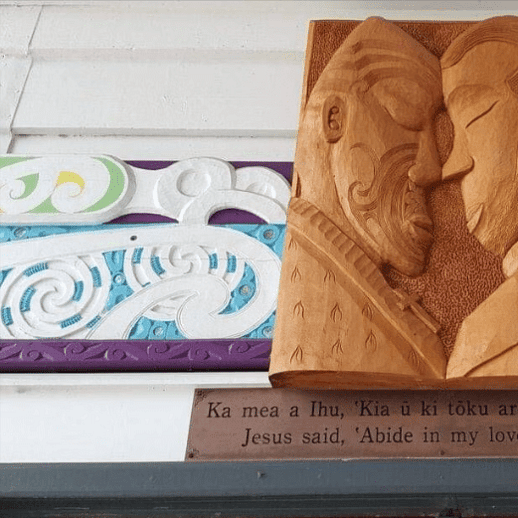
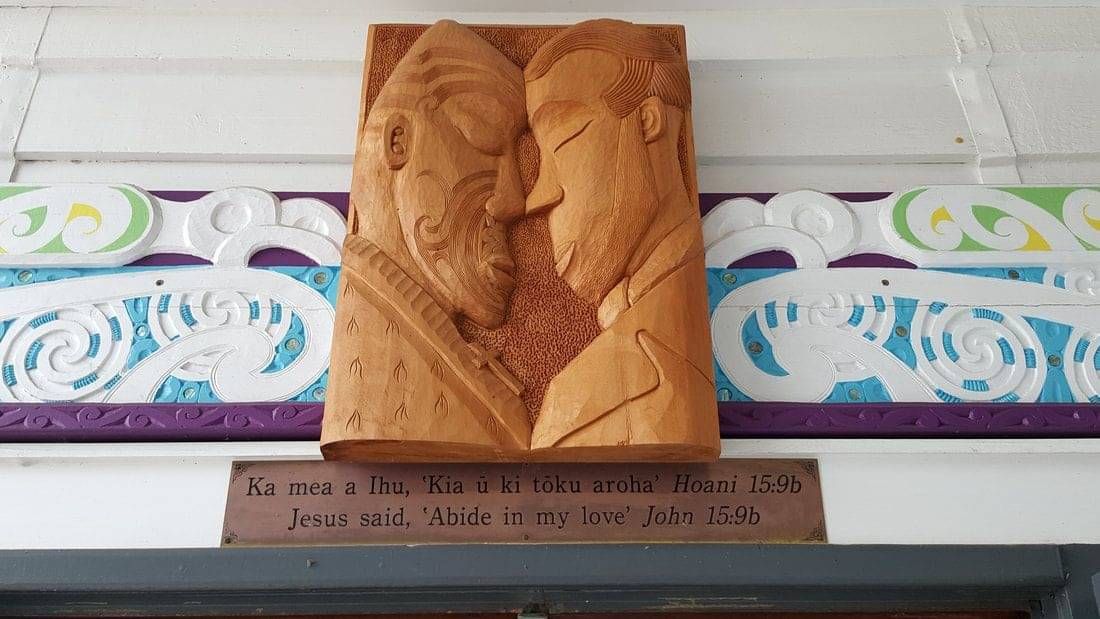
As the service began, a newly carved pare — a traditional Māori door lintel — was unveiled and blessed above the main entrance of Hiona St Stephen's.
It was carved in response to the Bill passed by Parliament in late 2013 — the formal restoration of Mokomoko's character, mana, and reputation. The church chose to mark that moment not with words alone, but with wood and hands and art.
The pare depicts Völkner (Wakana) and Mokomoko standing face to face, foreheads and noses touching, performing the hongi — the traditional Māori greeting in which breath is shared, and two beings become, for a moment, one.
They hold a Bible between them.
Two men who never met in peace. Who lived on opposite sides of a catastrophic collision. Who both died because of it. Now imagined — by the faith and courage of the people who came after them — pressed together in eternal reconciliation, breathing the same air, over the door of the church their lives were bound to.
The inscription carved with them reads:
Ka mea a Ihu, 'Kia ū ki tōku aroha' — Hoani 15:9b
Jesus said, 'Abide in my love' — John 15:9b
And beneath:
My peace I leave with you. — John 14:27
Every person who enters this building — visitor, worshipper, tourist, curious stranger — passes beneath that hongi.
You have just walked under it.
VI. The Pardon — In the Church Porch
The original Pardon document — presented by the Minister of Justice to the Mokomoko whānau at Waiaua Marae in 1993 — rests in the church porch. It is there at the request of the Mokomoko whānau, who asked that it be kept here, not in a government archive, but in this place — the place where the history happened, where the wound was opened, and where the healing continues.
You are welcome to stop and read it. Take your time. It is not a short story.
A Closing Word — He Kōrero Whakakapi
🌿 Te Reo Māori
Ko ēnei tohu, ehara i te mutunga o te kōrero. Ko ia tohu, ia tohu, he karanga anō — he karanga ki ō tātou ngākau kia haere tonu, kia ū tonu, kia aroha tonu.
Ko te ara o te hohou rongo, ehara i te ara māmā. He ara roa, he ara tūkino, he ara hūpē me te roimata. Engari ko tēnei ara, ko ia anō te ara ki te ao mārama.
Nō reira, e hoa mā — haere tonu. Kaua e huri whakamuri. Kei mua tonu he rā hou.
These symbols are not a conclusion. They are an ongoing invitation — to honesty, to courage, to the kind of love that does not look away from history but walks through it with open eyes and open hands.
The reconciliation they represent is real. It was hard-won, across generations, by whānau who kept faith when the Crown did not, by church leaders who chose humility over defence, and by the quiet, daily courage of communities choosing to stay in relationship across the wounds of the past.
But it is also unfinished.
The descendants of Mokomoko are still waiting for compensation. Te Whakatōhea's Waitangi Tribunal claims remain unresolved. The economic and cultural devastation of raupatu continues to shape the lives of real people in Ōpōtiki today.
The symbols on these walls do not say it is over. They say: this is the direction. They say: this is what love looks like, working in history. They say: abide in this.
No reira, waiho ko te aroha o Te Matua Kaha Rawa hei kākahu mō koe.
Let the love of Almighty God be a cloak around you.
